How Much and How Often Exercise for Cocker Spaniels?
Cocker Spaniels carry the legacy of a sporting breed, which means their DNA is coded for stamina and agility. These dogs need an outlet for that ingrained intelligence. A healthy diet is the foundation, but physical and mental challenges are what allow a Spaniel to truly thrive. Forget the generic advice of “a minimum of 45 minutes daily”. The true requirement is a flexible blend of walking, running, and scent work that respects the dog’s age and type. It’s not about exhausting them, but about fulfilling their deep-seated need to work their body and mind.
Age-Wise Exercise Time Duration
A dog’s physical capacity is intrinsically linked to its age. A six-month-old puppy’s growth plates are still vulnerable, while a ten-year-old veteran’s joints have seen a decade of enthusiastic sprints. Finding the right balance is key. Pushing a young dog too hard can lead to long-term issues like elbow or hip dysplasia, conditions to which the breed is predisposed. Under-exercising a healthy adult can result in obesity, which affects nearly 10% of the breed, or behavioural problems.
Exercise Needs for Cocker Spaniel Puppies
- 0-6 months: For the first few months, structured exercise is minimal. Short, 5-10 minute exploratory walks on grass after their vaccinations are sufficient. Most of their energy should be spent in the back garden. I used the “5-minute rule” as a loose guide for my own Cocker, adding five minutes of structured walking per month of age.
- 6-8 months: As their skeletal structure matures around six months, you can introduce longer walks. My pup at this age had boundless energy, so we focused on two to three shorter, 20-minute sessions rather than one long one to prevent joint strain.
- 8 months and older: By eight months, your puppy might act like they can keep up with adult dogs on a hike up Mam Tor, but their body isn’t ready. We kept our adventurous pup to a 40-minute daily maximum at this stage, focusing more on training than distance.
Exercise Needs for Adult Cocker Spaniels
The rigid “two walks a day” rule doesn’t fit every dog or owner. A more realistic approach for my adult Show Cocker is a 45 to 90-minute off-lead session in the morning, exploring the local woods, and a shorter 30-minute pavement walk in the evening. Weekends allow for longer adventures, perhaps a 5-mile circular walk along the Monsal Trail in the Peak District. This routine is about consistency, not just longevity.
Exercise Considerations for Senior Cocker Spaniels
My senior Spaniel, now 11, can no longer handle the strenuous runs he once loved. We’ve replaced them with gentler alternatives. Slow, 30-minute walks that allow for plenty of sniffing are now our standard. On days when his arthritis is bothering him, a dog stroller allows him to still enjoy the sights and smells of our familiar route. Always discuss exercise changes for senior dogs with your vet, especially if they are on supplements like Yumove for joint support.
Exercise for Working Cocker Spaniels
Working Cockers are a different calibre of athlete compared to their Show-type cousins. Their field-bred instincts for stamina don’t disappear in a pet home. Attempting to exhaust a Working Cocker through running alone is a fool’s errand; you will simply build a fitter athlete. They require a combination of physical exertion and complex mental work.
- Weekdays: Aim for 90 minutes to 2 hours of varied activity, split into two sessions. This could be a run combined with retrieving drills.
- Weekends: If the weather on the fells is decent, a single, longer hike or a session at a local dog swimming pond offers excellent conditioning.
Cocker Spaniel Exercise Chart By Age
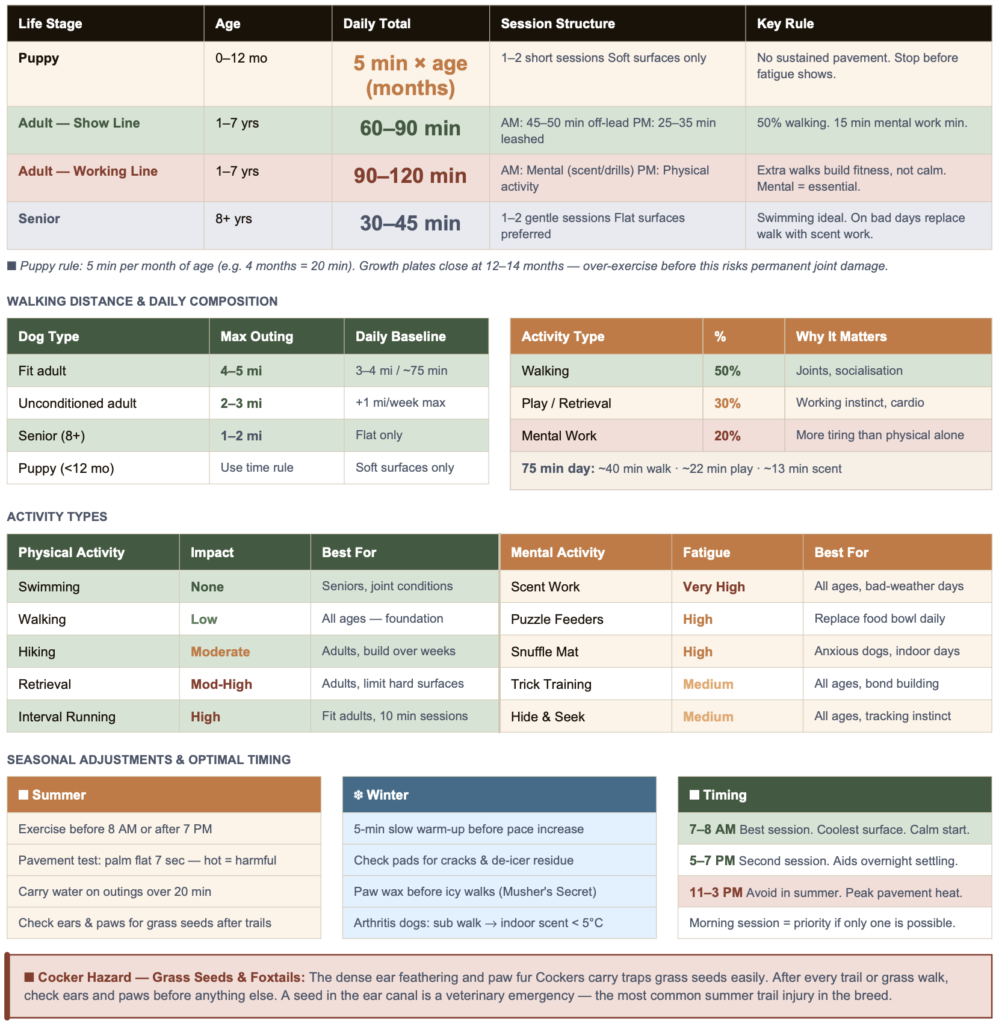
(This visual chart shows the average time needed to exercise your Spaniel with respect to age. You can also download our detailed chart with age-specific recommendations and suggested durations below:)
Types of Activities Good for Cocker Spaniels
Relying only on walking and running can lead to repetitive strain. A Cocker’s brain needs exercise just as much as its legs. Swimming is a fantastic, low-impact cardio workout. Hiking on varied terrain, like the public footpaths around the Peak District, builds resilience. My own Spaniel’s destructive tendencies vanished when I introduced focused brain work. Mental fatigue is more effective at calming a busy Cocker than physical fatigue alone.
Game Ideas and Other Activities to Make Them Happy
Activities like hide-and-seek or teaching complex new tricks provide vital stimulation. For my dog, a ‘clean up’ game where he puts his own toys away is a favourite job.
For Mental Stimulation:
- Progressing through The Kennel Club’s Good Citizen Dog Scheme (Bronze, Silver, and Gold levels).
- Feeding meals from a Trixie Dog Activity Carpet or a Nina Ottosson puzzle feeder instead of a bowl.
- Playing “find it” with high-value treats hidden around the house.
- Teaching the names of different toys.
How Much Walking?

A fit adult Cocker can comfortably walk up to 5 miles a day, but this is highly individual. A 45-minute daily walk is a reasonable baseline, but watch your dog. Are they lagging behind or still bouncing with energy at the end? Let their condition guide you. After a muddy trek through the woods, a proper paw clean is essential to remove dirt and potential allergens.
How Much Running?
Cocker Spaniels are built for agility and short bursts of speed, not long-distance marathons. With proper conditioning, they can become good jogging partners for short to mid-range distances. A quality harness that distributes pressure, like a Ruffwear Front Range, is a must-have to protect their neck and chest. Excessive running on hard surfaces can lead to joint injuries. Start with 10-minute intervals of running within a longer walk.
Benefits and Importance of Daily Exercise
The primary benefit of a walk is not to induce exhaustion, but to provide enrichment and socialisation. Daily, appropriate exercise delivers profound benefits:
- Physical Health: It’s the single best tool for maintaining a healthy weight, strengthening the cardiovascular system, and supporting muscle tone. This is crucial for a breed prone to hip dysplasia.
- Mental Stimulation: Engaging with the sights and smells of the outside world prevents boredom, which is a common root of unwanted behaviours like chewing or barking.
Seasonal Exercise Adaptations
Adjusting your routine to the UK’s seasons is vital for your Spaniel’s health.
Exercising in Summer
Shift walks to the cool of the early morning (before 8 AM) or late evening (after 7 PM) to avoid heatstroke. Always carry water. Be mindful of walking in woodland areas during autumn, as a rare but serious condition known as Seasonal Canine Illness (SCI) has been reported in regions like Thetford Forest and Sherwood Forest. Symptoms like vomiting and lethargy appear within 72 hours of a walk.
Exercising in Winter
A good quality coat can help keep a clipped Spaniel warm. Check paws after walking on gritted paths to prevent irritation from salt. On the coldest, wettest days, an indoor session of scent work or puzzle toys can be a perfectly acceptable substitute for a miserable walk.
Optimal Times of Day for Exercise
The coolest parts of the day, morning and evening, are generally best for vigorous exercise. A dog’s energy levels are often naturally higher during these times. However, the truly optimal time is one that fits consistently into your own schedule, ensuring the routine is maintained.
Final Words
A Cocker Spaniel doesn’t understand exercise quotas or breed-specific health risks like otitis externa, the painful ear inflammation common to the breed. That’s our responsibility as owners. The goal isn’t just to follow a set of instructions, but to observe, adapt, and build a partnership with your dog that brings you both satisfaction.