Show or Working Cocker? Which One Should You Get?
There’s a question I get asked almost every time I’m out with my two cockers. Woody, all silky curtains and slow, theatrical strolls, gets: “Oh, she’s gorgeous, what breed is she?” Followed immediately, when Wyn rockets past at the speed of sound with a woodpigeon feather stuck to his lip, by: “And what on earth is THAT?”
Same breed. Different planets.
I’ve had both a show-type and a working-type cocker spaniel living under the same roof for over 8 years. I’ve made mistakes with both. I’ve been surprised by both. I’ve been absolutely levelled by both, in completely different ways. This is the comparison article I wish had existed when I was doing my research, honest, granular, and not written by someone who has only read about cocker spaniels but never had their kitchen’s quartz worktop cleared of a chicken breast by a seven-month-old working cocker with a five-foot vertical.
Let’s get into it.
A Quick Word on Terminology (Because People Get This Wrong)
Before anything else: when people say “show cocker” or “working cocker,” they are almost always talking about the English Cocker Spaniel. This is one breed, split across two very distinct breeding lines. This is not the same as the American Cocker Spaniel, which is a separate breed entirely and rarely what anyone means in this context.
The split happened gradually over the 20th century as breeders optimised for different outcomes. Show lines were refined toward the Kennel Club breed standard: appearance, coat, conformation, and temperament for the ring. Working lines were refined toward performance in the field: flushing game on shooting days, hunting drive, stamina, and biddability.
Decades of selective breeding in opposite directions produced dogs that are, on paper, the same breed. In practice, they can feel like entirely different animals to live with.
The Core Differences
| Feature | Show Cocker Spaniel | Working Cocker Spaniel |
|---|---|---|
| Bred for | Conformation to breed standard | Field work, flushing, hunting, retrieving |
| Pedigree indicator | Sh.Ch. (Show Champion) in lineage | FTCH (Field Trial Champion) in lineage |
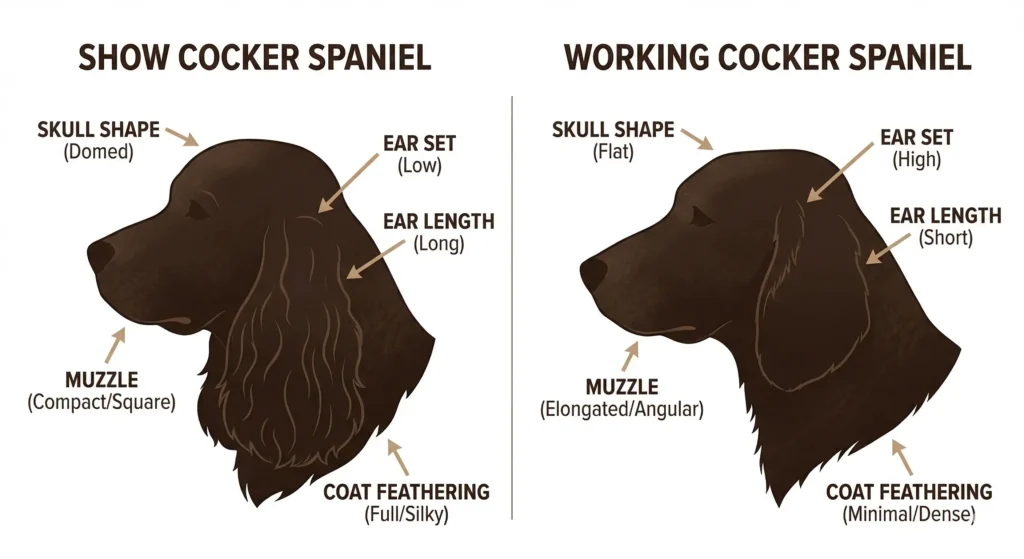
| Skull shape | Rounded, domed. “Teddy bear” profile | Flatter, more angular, elongated muzzle |
| Ear set | Low-set, long, heavily feathered | Higher-set, shorter, less feathering |
| Coat | Longer, silkier, fuller feathering on legs/chest/belly | Shorter, denser, more weatherproof, minimal feathering |
| Build | Compact, square, balanced | Leaner, more athletic, slightly longer in body |
| Resting state | Happy to settle, will nap with you | Rarely fully switches off |
| Energy level | Moderate. Active but manageable | High. Often described as relentless |
| Trainability | Responsive, sensitive, eager to please | Highly trainable but needs mental outlets or it finds its own |
| Grooming demand | High. Regular professional grooming often needed | Moderate. Still needs work, but far less coat to manage |
| Best suited to | Active families, first-time spaniel owners | Active owners, gundog enthusiasts, experienced handlers |
| Avg. Weight | 13–14.5 kg | 12–14.5 kg (highly variable) |
| Health screening | BVA eye scheme, hip scoring, gonioscopy | BVA eye scheme, hip scoring, AMS (acral mutilation syndrome) in some lines |
The Show Cocker Spaniel: Conformation, Character, and Coat
What They Look Like

The show cocker’s silhouette is what most people picture when they think spaniel. A slightly rounded skull. A square, well-defined muzzle. That low, pendulous ear is long enough that it nearly reaches the end of the nose when pulled forward, heavily fringed with silk. The body is compact and square, sitting within an imaginary box, with well-angulated hindquarters and a level topline.
The coat is the showstopper. On a well-kept show cocker, the chest, belly, and legs carry sweeping feathering that moves when they walk. Colours run the full spaniel spectrum, golden, liver, black, blue roan, orange roan, liver roan, parti-colours. The blue roan is arguably the most distinctive: a close-mixed salt-and-pepper effect across the body with ticking, giving the coat an almost painted quality.
That coat is also the source of significant work.
Temperament: What They’re Actually Like to Live With
Show cockers have a reputation for being the calmer, more domesticated of the two, and in most cases, that reputation is earned. They tend to bond deeply with their family, are often described as “velcro dogs,” and carry a warmth that makes them lovely companions in a family setting.
Woody, and Wilma, my show girls, will follow me from room to room. They will sit quietly beside my desk while I work. She will request fuss with a single paw placed deliberately on my knee, not urgently, but persistently, as if filing a formal application. She is gentle with children. She meets strangers with enthusiasm. She settles in the car, in crowded pubs, and in new environments.
What she is not is inert. Show cockers still need daily exercise, a good hour minimum, and can become anxious or destructive if under-stimulated or left alone too long. They’re sensitive dogs. Raised voices or harsh correction can shut them down emotionally, setting training back weeks. They want to please you, but need consistent, patient, reward-based methods in return.
Energy Level
Moderate to moderately high. Not a lap dog. Not a working line. Two good walks a day, some off-lead sniffing time, a bit of training or a scatter feed, and Woody is satisfied and settled by evening. She doesn’t pace. She doesn’t whine. She sleeps.
Each dog is an individual. Some show-bred cockers carry more drive, depending on how recently working genetics were introduced. Always look at the parents, not just the breed type.
Grooming: The Real Cost of That Coat
This is where the show cocker’s high-maintenance reputation is entirely deserved.
That flowing feathering mats. Regularly. Even with daily brushing with a good slicker brush, a show cocker in full coat needs professional grooming every six to eight weeks. Ears require weekly checks and cleaning with a solution like Virbac Epi-Otic; the combination of long, heavy leather and restricted airflow makes them a hotspot for yeast infections. After a walk through autumn woods, expect to spend time picking out burdock burrs and cleavers.
If you aren’t planning to show, many owners opt for a “pet trim,” keeping the body shorter while retaining the ear fringe and some leg feathering. This significantly reduces the maintenance but doesn’t eliminate it. Budget for grooming costs. They are a genuine line item in the budget.
The Working Cocker Spaniel: Drive, Build, and Brain
What They Look Like


Stand a working cocker next to a show cocker, and the differences are apparent. The working dog is leaner, built for function. Longer in the leg relative to the body. Less domed in the skull, with a flatter top of the head. The ears sit higher on the skull and are shorter. The muzzle is often described as more workmanlike.
The coat is the most obvious difference. Shorter, denser, less dramatic feathering, it’s designed to move through bramble without collecting all of it. A working cocker coming out of a hedgerow picks up debris, but nothing like the quantity that clings to a show coat. The fur feels coarser, more practical, and water-resistant.
Working cockers are often legally docked, the tail shortened, though this is less common now. Full-tailed workers are becoming standard. Colours are frequently the same as show lines, though liver and white and black and white appear more often in working pedigrees.
Temperament: What They’re Actually Like to Live With
I’ll be honest: the working cocker is not always the easiest dog to live with if you don’t know what you’re signing up for.
Wyn is magnificent. He is also completely and permanently switched on. He wakes ready to work. He approaches a walk on the South Downs Way not as exercise but as a task, nose down, quartering, covering ground with methodical intensity. He can cover five kilometres while I’ve covered one. He has jumped onto the kitchen worktop. He has dismantled a ‘Kong Extreme’ toy in eleven minutes. He has excavated a section of the garden with a focus I genuinely admire and also find exhausting.
He is also, when properly exercised and mentally engaged, the most joyful, responsive dog I’ve ever trained. He learned “leave it” in two sessions because he wanted to. Working cockers train brilliantly when you make the training feel like a job. Give them something purposeful to do, and they light up. They have a gear that, if you don’t find an outlet for it, they’ll find their own.
Energy Level
High. Genuinely high. Not anxious or frantic, but the sustained, purposeful, I-could-do-this-all-day energy that comes from being bred to work an eight-hour shooting day without flagging.
An hour’s walk will not fully tire a working cocker. Two hours of physical exercise plus meaningful mental stimulation, scent work, retrieves, a training session, will begin to take the edge off. Gundog training classes, agility, canicross in a place like Thetford Forest, and flyball are popular outlets. Some owners participate in working tests with clubs like the Kent Working Spaniel Club or go picking-up during the pheasant season (Oct 1st – Feb 1st).
The trap is assuming physical exercise alone is sufficient. It isn’t. A working cocker that is physically tired but mentally unoccupied will still be a problem. The brain needs working as much as the body.
Grooming: Easier, But Not Zero Effort
The working cocker’s coat is substantially more manageable, but don’t confuse that with “no maintenance.” A worker going through cover will return with burrs and seeds embedded in their coat, particularly in the ear fringe and feet. This needs attention after every serious outing.
Regular brushing, a few times a week, prevents matting. Professional grooming every ten to twelve weeks is reasonable for a pet. Ears still need regular checking. If your dog swims, and many will swim anywhere they can, dry the ears thoroughly afterwards. The grooming bill is lower than a show cocker’s; the post-walk mud situation is identical.
Temperament & Trainability: Understanding What’s Going on in Their Heads
Both types are intelligent, sensitive, and people-oriented. Both want to work with you. The texture of that relationship differs.
Show cockers are softer and more sensitive to correction. This makes them excellent for positive reinforcement training, like clicker training based on Karen Pryor’s methods, and poor candidates for compulsion. Harsh training damages them. Apply consistent, reward-based methods and they progress quickly, happy to work at a relaxed pace.
Working cockers are also sensitive, but have a stronger independent streak when a scent is involved. The nose switches on and the ears switch off. This isn’t defiance; it’s instinct. Getting reliable recall on a working cocker requires more effort than most people expect, but it’s achievable. A working cocker that has been through a proper gundog foundation program is one of the most responsive dogs you will encounter. They pick things up fast, sometimes faster than you’re ready for.
Both types benefit from training that starts early and runs consistently. These are not dogs that want to learn something once and then retire.
A Day in the Life: Show Cocker vs Working Cocker
Show Cocker: A Tuesday with Woody
6:30am – Woody surfaces from her bed. Stretches dramatically. Presents herself for morning fuss.
7:15am – Morning walk, one hour. On-lead for the first five minutes, then off. She covers ground at a sensible pace, sniffs interesting spots, and checks in every few minutes. Returns when called.
8:30am to 12:30pm – Woody sleeps under my desk. Occasionally rests her chin on my foot. She files the formal application for fuss at 11am.
12:30pm – Short ten-minute garden wander.
4:30pm – Second walk, forty-five minutes. Similar pattern to the morning.
Evening – Woody settles on the sofa. Participates in a brief training session. Receives her evening meal. Sleeps deeply by 9pm.
Grooming check – Ears checked Monday and Thursday. Brushed daily.
Working Cocker: A Tuesday with Wyn
6:00am – Wyn is awake. Vibrating slightly.
7:00am – Walk, one hour minimum. Off-lead in a field. He covers three times my ground, nose down, quartering in wide arcs. I work on recall games throughout. He flushes a pigeon and handles the disappointment. He swims in the River Test. He is retrieved from the river.
8:30am – Fed. Settles, but remains alert, waiting for the next thing.
10:30am – Scatter feed in the garden. His kibble is hidden in the grass for him to find. Fifteen minutes of this buys an hour of calm.
11:30am to 2:30pm – Sleeps. A real, actual sleep. This is the window.
2:30pm – Training session, twenty minutes. We’re working on directional casting. He is brilliant at it.
4:30pm – Second walk, forty-five minutes. Repeat of the morning.
Evening – He can settle now. He likes the sofa, still aware of everything outside, but the edge has gone. He sleeps well.
Grooming check – Ears checked after both walks. Quick brush to remove field debris.
Myth vs Fact: The Biggest Misconceptions About Both Types
MYTH: “Working cockers are untrainable.”
FACT: Working cockers are highly trainable. The challenge is that their instincts need channelling. An under-stimulated working cocker appears untrainable because it’s too busy following its nose to listen. Channel that drive, and you’ll have an exceptionally responsive dog.
MYTH: “Show cockers are lazy.”
FACT: Show cockers are calmer, not lazy. They still need regular, meaningful exercise. The difference is that once their needs are met, they genuinely want to rest. An under-exercised show cocker becomes anxious and difficult.
MYTH: “Working cockers are too much for a family with children.”
FACT: Working cockers can be excellent family dogs, but they require an active family that enjoys training. An under-exercised worker in a quiet household with small children is a recipe for frustration.
MYTH: “Show cockers are just pet dogs.”
FACT: Show cockers still carry spaniel instincts. Many love agility, scentwork, and even gundog basics. They just lack the same intensity of drive as their working cousins.
MYTH: “You can always tell which type a puppy is.”
FACT: You often can’t. Coat and skull differences become more pronounced with age. Some dogs from mixed lineage sit in the middle. Asking for pedigree documentation, looking for Sh.Ch. or FTCH prefixes in the first three generations, is the most reliable indicator.
MYTH: “Cockers are prone to ‘rage syndrome.'”
FACT: True rage syndrome, a neurological condition causing unprovoked aggression, is real but extremely rare. According to veterinary neurology sources, it is far more commonly invoked to explain aggression that is actually the result of pain (ear or dental pain), fear, or poor socialisation. If your cocker is displaying aggression, see your vet for a full workup before concluding anything genetic. The vast majority of cockers are gentle, sociable dogs.
Health Considerations: What You Need to Know Before You Buy
Both lines share a genetic foundation and some health vulnerabilities.
Shared Health Concerns
Ear health is the universal cocker issue. The long, low ear creates a warm, dark environment perfect for yeast and bacteria. Both types are prone to otitis externa. Regular ear cleaning is non-negotiable.
Eye conditions are significant. Progressive Retinal Atrophy (PRA) causes blindness. Reputable breeders test their stock under the BVA/KC/ISDS eye scheme. Gonioscopy, a test for glaucoma risk, is also recommended. Ask for certificates, not verbal assurances.
Hip dysplasia occurs in both lines. Hip scoring under the BVA scheme gives a numerical score for each hip; lower scores are better.
Show Line Specific Concerns
Show cockers have historically had higher inbreeding coefficients (COI) in some populations. The Kennel Club’s “Mate Select” online service allows you to check the COI for registered litters. A puppy with a coefficient well above the breed average is a conversation to have with the breeder. Obesity is also more common in show lines.
Working Line Specific Concerns
Acral Mutilation Syndrome (AMS), a neurological condition causing self-mutilation of the feet, has been documented in working spaniels. It’s rare, but responsible breeders should be aware of it. Working cockers also sustain more physical injuries like pad cuts, barb wire tears, and muscle strains. A good first aid kit is essential.
What to Ask Every Breeder, Regardless of Type
- Can I see the BVA eye scheme certificates for both parents (dated within the last year)?
- What are the hip scores for both parents?
- Has gonioscopy been performed?
- What is the inbreeding coefficient of this litter, as calculated by the KC Mate Select tool?
- Has DNA testing been done for FN and PRA?
- What health conditions have appeared in your lines previously?
A breeder who becomes defensive when asked these questions is a breeder to walk away from.
Which Cocker Is Right for You? A Lifestyle Match Guide
Be honest with yourself. This is a twelve-to-fifteen year commitment.
You’d Likely Suit a Show Cocker If…
- You want a deeply affectionate companion for family life.
- Your daily exercise is two moderate walks, about an hour total.
- You work from home or can have the dog with you most of the day.
- You’re prepared to invest in regular, professional grooming.
- You want a dog that settles beautifully in the evenings.
- You have limited experience with high-drive working breeds.
You’d Likely Suit a Working Cocker If…
- Your lifestyle is already active: hiking in the Peak District, running, long country walks.
- You are genuinely interested in dog training as an ongoing hobby.
- You have outdoor space and access to fields or woodland.
- You’re interested in gundog work, agility, or another dog sport.
- You have previous experience with high-energy working breeds.
- You can provide significant time daily for both physical and mental exercise.
The Grey Zone
If you’re in the middle, consider a show-bred cocker from working-adjacent lines, or a working-bred cocker from calmer, pet-focused lines. A good breeder, like those registered with The Cocker Spaniel Club of Scotland or the London Cocker Spaniel Society, can guide you.
How to Tell Them Apart as Puppies (or in a Rescue)
This is difficult. Puppies change substantially.
Pedigree is the most reliable indicator. For KC-registered dogs, look for affix names and titles. Sh.Ch. (Show Champion) indicates show breeding. FTCH (Field Trial Champion) prefixes, from names like Mallowdale or Wernffrwd, indicate working breeding.
Skull shape becomes more apparent around twelve weeks. The domed show skull and flatter working skull are usually visible by then.
Instinct can be observed early. Watch how a puppy responds to scent. In rescue, assume you cannot tell. Assess the individual dog’s behaviour, not an assumed type.
Finding a Reputable Breeder: Red Flags and Green Lights
Green Lights
- The breeder is a member of a regional club like the North of England Cocker Spaniel Association.
- Both parents have full, documented health tests.
- You can meet the mother in her home environment.
- The breeder asks you many questions about your lifestyle.
- Puppies are raised inside the home.
- They offer a contract with a return-to-breeder clause.
- They remain available for support after you take the puppy home.
Red Flags
- Health certificates cannot be produced.
- You cannot meet the mother.
- The puppy is available immediately with no waiting list.
- You are offered a choice of several litters at once.
- The meeting is offered in a neutral location like a car park.
- The price is significantly below the breed average.
Expert Tips Worth Taking Seriously
Start recall training before anything else. For working cockers especially, reliable recall is the foundation. Use a long line for the first months. Proof it in difficult environments.
Ear infections caught early are manageable. Buy a good ear cleaning solution and make checks a weekly ritual. The early signs, a slight smell or redness, are easy to miss.
Don’t skip the 3-12 week socialisation window. Expose your puppy carefully to many environments, sounds, and people. A cocker that has encountered traffic, children, and the vet’s table before fourteen weeks will be an easier adult dog.
Mental tiredness is real. A twenty-minute training session can tire a dog more than an hour’s walk. This is a critical tool for managing a working cocker.
Groom from day one. Handle your cocker’s ears, paws, and coat from the first week home. Make it a positive ritual, not a battle.
Conclusion: Two Cockers, One Honest Assessment
Woody, Wilma and Wyn are all brilliant dogs. They share the same bounce when the leads appear. They share the same melting softness when they lean against your legs. They share that essential spaniel capacity for filling a room with warmth.
But they have required completely different things from me. Woody has needed patience, emotional attunement, and a serious commitment to her coat. Wyn has needed structure, purpose, intense mental challenge, and a training commitment that never stops.
Neither is harder than the other. They’re differently hard. Both are worth it, but only if you’re honest about which version of “hard” you’re prepared for.
If you’re on the fence, visit both types. Spend time with owners of both. Talk to breeders who will be honest about lifestyle fit. The right dog is out there. It’s just a question of making sure you’re meeting each other halfway.